logo
Shanghai Tankii Alloy Material Co.,Ltd
Produk
Rumah /

Produk

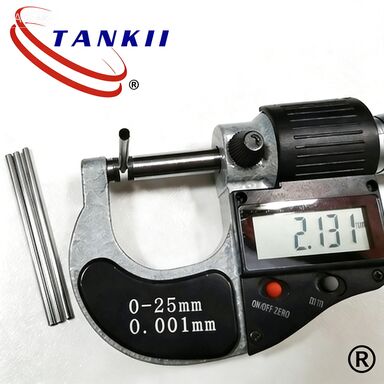
Kovar Alloy Expansion Alloy Tube 5mmx1mm 6mmx1.5mm for Glass-to-Metal Sealing Process

Rincian Produk

Tempat asal: Shanghai, Tiongkok

Nama merek: TANKII

Sertifikasi: ISO9001

Nomor model: FeNi29Co18

Ketentuan Pembayaran & Pengiriman

Kuantitas min Order: 5kg

Harga: dapat dinegosiasikan

Kemasan rincian: karton + kasus kayu

Waktu pengiriman: 7-20 hari

Syarat-syarat pembayaran: L/C, T/T, Western Union

Menyediakan kemampuan: 100 Ton per bulan

Dapatkan Harga Terbaik
Hubungi sekarang
Spesifikasi
Menyoroti:

Kovar alloy sealing tube

,

Expansion alloy 29HK tube

,

Precision alloy sealing tube

OD:
Minimal 0,3 mm.
WT:
menit 0,01 mm.
Bahan:
Paduan Nikel Besi
Membentuk:
strip, batangan, kawat, lembaran, tabung
Aplikasi:
Industri, Industri listrik & elektronik, ukiran CNC, industri instrumen presisi, Metalurgi
Kepadatan:
8,20 gram/cm3
Permukaan:
Permukaan terang
OD:
Minimal 0,3 mm.
WT:
menit 0,01 mm.
Bahan:
Paduan Nikel Besi
Membentuk:
strip, batangan, kawat, lembaran, tabung
Aplikasi:
Industri, Industri listrik & elektronik, ukiran CNC, industri instrumen presisi, Metalurgi
Kepadatan:
8,20 gram/cm3
Permukaan:
Permukaan terang
Deskripsi
Kovar Alloy Expansion Alloy Tube 5mmx1mm 6mmx1.5mm for Glass-to-Metal Sealing Process

TK411-29 (Kovar Expansion alloy)
(Common Name: Kovar, Nilo K, KV-1, Dilver Po, Vacon 12) TK411-29 also known as Kovar alloy. it was invented to meet the need for a reliable glass-to-metal seal, which is required in electronic devices such as light bulbs, vacuum tubes, cathode ray tubes, and in vacuum systems in chemistry and other scientific research. Most metals cannot seal to glass because their coefficient of thermal expansion is not the same as glass, so as the joint cools after fabrication the stresses due to the differential expansion rates of the glass and metal cause the joint to crack.

K411-29 was invented to meet the need for a reliable glass-to-metal seal, which is required in electronic devices such as light bulbs, vacuum tubes, cathode ray tubes, and in vacuum systems in chemistry and other scientific research. Most metals cannot seal to glass because their coefficient of thermal expansion is not the same as glass, so as the joint cools after fabrication the stresses due to the differential expansion rates of the glass and metal cause the joint to crack.

K411-29 not only has thermal expansion similar to glass, but its nonlinear thermal expansion curve can often be made to match a glass, thus allowing the joint to tolerate a wide temperature range. Chemically, it bonds to glass via the intermediate oxide layer of nickel oxide and cobalt oxide; the proportion of iron oxide is low due to its reduction with cobalt. The bond strength is highly dependent on the oxide layer thickness and character. The presence of cobalt makes the oxide layer easier to melt and dissolve in the molten glass. A grey, grey-blue or grey-brown color indicates a good seal. A metallic color indicates lack of oxide, while black color indicates overly oxidized metal, in both cases leading to a weak joint.

Mainly used in electric vacuum components and emission control, shock tube, igniting tube, glass magnetron, transistors, seal plug, relay, integrated circuits lead, chassis, brackets and other housing sealing.


ormal composition%

Ni 28.5~29.5 Fe Bal. Co 16.8~17.8 Si ≤0.3
Mo ≤0.2 Cu ≤0.2 Cr ≤0.2 Mn ≤0.5
C ≤0.03 P ≤0.02 S ≤0.02    


Tensile Strength, MPa

Code of condition Condition Wire Strip
R Soft ≤585 ≤570
1/4I 1/4 Hard 585~725 520~630
1/2I 1/2 Hard 655~795 590~700
3/4I 3/4 Hard 725~860 600~770
I Hard ≥850 ≥700


Typical Physical properties

Density (g/cm3) 8.2
Electrical resistivity at 20ºC(Om*mm2/m) 0.48
Temperature factor of resistivity(20ºC~100ºC)X10-5/ºC 3.7~3.9
Curie point Tc/ ºC 430
Elastic Modulus, E/ Gpa 138
Kirim pertanyaan Anda
Silakan kirimkan permintaan Anda kepada kami dan kami akan membalas Anda sesegera mungkin.
Mengirim